

(by Nikolaus Mach-Hour / VP Global Strategy)
For decades, the topic of how to transform Japanese companies globally has been fascinating to me.
2026 marks JCO's 20th anniversary, and I think this is a great opportunity to provide a status check of where our customers stand regarding global transformation.
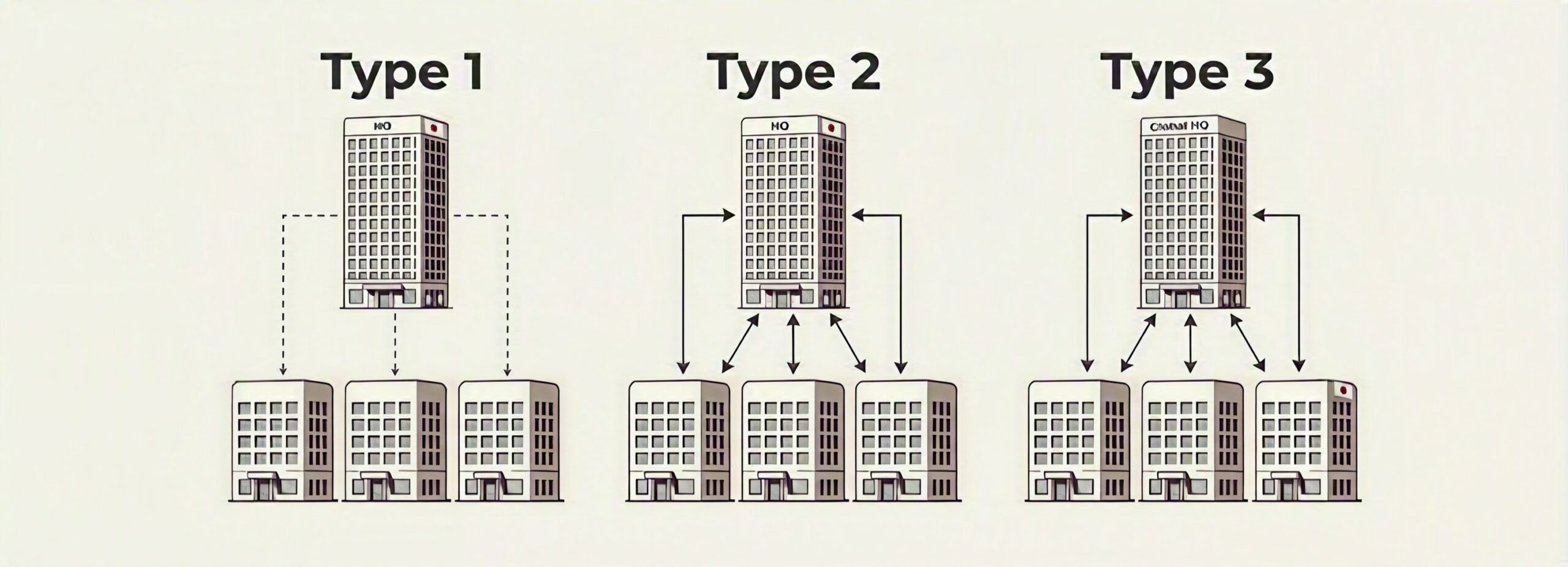
I have been stressing for a long time that there is no "typical" Japanese company culture any longer. As JCO not only supports major Japanese corporations but also counts hundreds of small and medium-sized companies among its customers, we were able to identify 3 main types of global transformation levels.
Type 1: Japan-Centric / Strong Silo Tendency
These companies often feature siloed operations between the Japan headquarters and overseas subsidiaries and usually lack a CHRO role or a global HR infrastructure.
Type 2: Strong Japan HQ / Partially Aligned
In these organizations, the Japan HQ usually coordinates global initiatives that are supported by regional hubs. Some change initiatives are driven by overseas subsidiaries (based on regional pilots) and there are often non-Japanese executives at HQ level.
Type 3: Global Matrix / Japan as Regional Hub
Operating from a global HQ outside Japan, these firms relegate the Japanese entity to a regional hub, at times diminishing the visibility and strategic influence of Japanese personnel in major global projects.
Even though each category faces its own set of challenges, it is tempting to assume that, when it comes to global transformation, Type 2 is in the “Goldilocks” zone.
Namely, not too old-fashioned to fall behind yet not too global to risk losing its Japanese roots.
So, let's zoom in on Type 2 and try to see whether hidden challenges persist despite the high level of transformation. We will also review if new unexpected issues might have been created because of the change.
I hope the following analysis can help you assess your own organization's transformation level! (More examples will follow in an upcoming article).
Transformation trend #1: Non-Japanese experts and executives at HQ in Japan
In many Japanese corporations that fall into Type 2, non-Japanese experts up to executive level are working directly at the HQ. Many of them are seconded from a subsidiary or travel back and forth regularly.
Benefits of this trend
Having important roles filled by non-Japanese professionals provides a vital global outlook to both the executive teams at HQ level as well as the wider departments they work with, often as CHRO, CFO, CIO or CMO.
A higher speed of action as well as change management with a larger scope are possible when non-Japanese executives not only have a clear vision but also know how to navigate a Japanese HQ throughout all the organizational layers.
Hidden challenges remain
On the other hand, simply appointing non-Japanese executives to the HQ, relocating them and providing light Japanese language lessons is not enough.
Let me break down the 3 angles that need to be aligned.
A. The non-Japanese perspective
First, there are the experts or executives themselves who need to be fully aware of the current "change readiness" stage on the Japan side.
I have seen too many professionals bump their heads when they attempted to deploy a "let’s get a lot of change done during my first 100 days" approach to leadership.
On top of that, there are often different assumptions when it comes to titles like "global head/director of XYZ". More often than we would expect, Japanese colleagues have to explain that "in our organization, global refers to the whole world while, of course, excluding Japan".
In summary, the non-Japanese arrivals need to learn the "rules of the game" first before they can bend and possibly change them later.
B. The immediate Japanese teams the non-Japanese at HQ are working with
The second angle is closely connected to the first point and is about how efficiently the immediate Japanese teams/departments are interacting with foreign experts and executives once they arrive at the HQ.
Too often, Japanese teams assume that a non-Japanese colleague with experience at an overseas subsidiary will automatically integrate smoothly at headquarters.
But as work styles at the HQ and at the overseas subsidiaries differ in many aspects, it is vital to offer training on communicational and cross-cultural topics to not only the new arrivals but also to their Japanese colleagues.
Repeatedly, I have seen different values and perceptions on “how to get things done” lead to real problems in the mid-term.
These issues can arise from different views of "how to responsibly assess business risks and opportunities" or “how to define agility”. But it can also be about small things like the usage of personal expenses by non-Japanese executives.
C. The organizational angle in Japan
Of course, we cannot disregard the wider organization at HQ level because it has to accommodate non-Japanese experts and executives.
Simply being introduced internally and externally with a lot of fanfare cannot replace real integration into official and unofficial channels.
Often, we hear of top-level meetings (50 top executives of a BU etc.) being run in Japanese language only (presentations, materials, discussions) even though 5 of the participants do not speak it and are not provided an interpreter. In some edge cases, non-Japanese executives were being excluded from more informal top-level meetings held in Japanese.
On the customer-facing side, client presentations/fairs at HQ are, at times, organized fully in Japanese without any English material available.
As a result, in many cases non-Japanese working at HQ level might feel that they are never “fully in the loop" after the onboarding phase.
The big picture
If you are part of a Japanese organization that is undergoing a transformation currently (which are all of them...), I highly recommend checking all 3 perspectives above for pain points and blind spots.
If "things in Japan are mostly being done as they always were” even though a lot of effort and investment has been put into installing non-Japanese experts and executives at the HQ level, then it is obvious that the full rewards of this strategy cannot be reaped. I cannot stress enough that the Japanese organization needs to consciously evolve too over time.
In Part 2 of this series, we will explore further examples, for example why projects between the HQ and the regions sometimes drag on for a long time or why regional initiatives sometimes stall.
Real integration takes more than just good intentions, so JCO has specific programs from individual coaching to complex multi-tier packages to address challenges like these.